|
Islam
in Scotland
& The Educational Needs of Muslim Children
|
(OHP
- Bismillah)
 |
|
May I begin in the traditional muslim way, in the
Name of the All-Merciful and All-Compassionate - if that's not
seen as too terribly anti-academic. But it's an excuse to show
you what I used to do when I worked as a calligrapher.
Islam
in Scotland was supposed to be Ahmad Andrews' topic, as it's
his special interest and approach, the various muslim
groupings, their roots and branches and what differentiates
them. As I also know a bit about it however, Malory asked me
to cover it, but I must say that I am always in two minds with
regard to reductive analysis, this process of reducing things
to a myriad definable separate parts.
In
fact, when talking to educationists I always stress that the
recognition of muslim variety is a first essential, as many of
the difficulties that non-muslims have when trying to relate
to the muslim community stem from an urge to homogenise it and
search for one voice that speaks for them all.
But
muslims comprise a sixth of the world's population, belong to
every ethnic group in countries surrounding the globe, and
have been around for over fourteen hundred years. As with the
Christian world, there has been and is a fairly wide variety
of individuals and organisations in there. With regard to the
view of things Islamic as uniform and isomorphous, one needs
to substitute "Christianity" for "Islam"
to see how ridiculous the picture will look. Revolutionary
Nicaraguan Jesuitism is a far cry from the politics of the
Reverend Ian Paisley, or, for that matter the Maronites of
Lebanon. Try asserting the essential identity of Cathars,
Flagellants, Rasputin and the Dutch Reformed Church and you
would quickly be laughed out of Court - but people regularly
make equivalent comparisons with regard to the muslim world.
My
fears of reductive analysis are also quite strong, however, as
when those with little knowledge of a broader picture
concentrate on examining details of difference it can lead to
a bizarre perception of the nature of the beast. Dissection
may make it easier to examine the biological mechanics of a
butterfly, but you no longer get to see it flutter.
The
global variety of muslims can be seen reflected in the muslim
population now living permanently or temporarily in Scotland,
with all the friendships and feuds, agreements and arguments
that might be found in the billion strong muslim population
strung around the world. And as few non-muslims even have a
clear idea of the difference between Sunni and Shi'a, rather
than a discussion of doctrinal difference I thought it might
be more useful to talk of the relationship between the
community and its mosques.
Until
the 1960's very few muslims lived in Scotland, and almost all
had been born in muslim countries overseas. Some had come to
Scotland to settle and find work, and some were here to study
at the Universities and colleges. They were from the Arab and
African countries, Malaysia and Indonesia, Persia, India and
Bangladesh, but most were from Pakistan.
On
Fridays they would meet in someone's house, at their
workplace, or in a room at the University, to make their
Jummah Salat together. As the number of muslims in the
community grew, more space was needed to cope, and in those
areas where there were a lot of muslims they would join
together and buy a building to use as a mosque.
Mosques
are not like churches. There is rarely any hierarchical
organisation of clergy, and they are usually run by an ad-hoc
committee formed from those who financed the building, who
employ someone to look after the mosque and act as the Imam
for the five daily prayers. He will give the sermon at the
Friday prayer and usually run classes in Qur'an for the
children.
Different
mosques would cater for the different language communities,
Urdu, Bengali, Farsi, etc. (though it is possible for any
muslim to pray in any mosque, as the Salat and the Qur'an are
always in Arabic), and different mosques are often maintained
by various organisations based in the country of origin of the
local mosque community.
There
are a variety of mosques in most of the main cities in
Scotland - the bigger the population the more the variety. In
Glasgow the last time I counted there were a dozen, serving a
population of between 20 and 30 thousand (depending on who you
ask). Only two have been purpose built, and the rest are in
converted small terraced houses, in large detached houses, in
adapted commercial buildings or converted church halls.
Mosques
are not just there for prayers, however, they are also
community centres, and perhaps more importantly centres of
community prestige, funding and political power, and the cut
and thrust of that side of them can sometimes make them seem
very remote from the spirit. In Glasgow we have two Shi'a
mosques (one Iran-led, one Iraqi-led), one Bengali mosque, an
Arab centre, the U.K.Islamic Mission or the Jama'at Islami, a
Barelwi mosque, a Tablighi Jama'at mosque, the cash-and-carry
Central Mosque and so on. And then there are the weekend and
night schools, of which there are more than the mosques (with
at least four Arabic language schools for a start - including
two Libyan schools and a Saudi school). Plus, there are well
over a thousand Malaysian students, Indonesians, Nigerians,
and on and on (and to cap it all a large Ahmadiyya centre, the
members of which are considered non-muslim heretics by all the
others) - really quite outside the scope of a brief survey.
So,
having recognised that the muslims have their differences,
what do they have in common?
(OHP
Umbrella) This is a diagram I use to show one way to approach
it. I have been known to extemporise around this for several
hours, but I will try and do it in five minutes.
Amidst
all their differences muslims share a common human trait, and
tend to reinforce their personal tastes and beliefs by seeing
them as normative. For non-muslims with no personal contact
with muslims, it can be very difficult to find out what the
muslim world community really have in common, and establish an
Islamic framework from which to examine and evaluate muslim
differences of opinion. For those having limited contact with
a small number of muslims, that task may often seem even
harder.
One
may be told that imagery is forbidden in Islam, yet remain
aware that in the muslim world advertising images abound,
images of the local ruler gaze down from nearly every wall,
and the flickering images on the TV screen are as prevalent as
anywhere else in the world. One may hear that music is
forbidden, yet know that muslims all around the world have
their own regional folk songs and musical traditions that can
be heard on the local radio, or bought as cassettes in the
local market. Styles of dress that are considered essential in
some regions are clearly not universal, and practices that
some muslims make central to their worship are denounced as
unislamic by others. When considering the huge cultural
variety of the muslim world, how can it be sorted into some
kind of order?
The
first key to avoid confusion is to recognize that the word
"Islam" is used in two very different ways. It has
both a general and a specific meaning. Its general meaning
would be better expressed as "The World of Islam",
and is used as an umbrella term to embrace all the cultural
variety of the muslims, with their different languages,
literary traditions, fashions and foods, tastes in art and
architecture, social norms and niceties etc. This world of
Islam is based on the interrelationship of three areas of
muslim experience known as Ihsan, Iman, and Islam in its
specific meaning. Here the word Islam refers only to the Five
Pillars of Islamic practice (those things which distinguish
muslims from everybody else). Iman, translated as faith or
belief, relates to those aspects of creation which are beyond
logical proof, but which we need to understand for our life
experience to be based on truth (a language that muslims share
with believers of several other faiths). Ihsan translates as
goodness and is the language of moral values (a language that
muslims share with the human community at large).
The
understandings covered by these three terms are interwoven
throughout all areas of muslim life. All knowledge (known in
Arabic as 'Ilm) is founded on them, and the muslim concept of
worship (Ibadat) is not restricted to the five pillars but
extends through Iman and Ihsan throughout the whole of a
muslim's life experience. All three terms are integral to Deen,
the Islamic way of life, and hence to Shari'ah, the definition
of that way of life in terms of the necessary legal structure
required for a muslim community to live together in harmony.
Of course, the Qur'an and the Sunnah of the Prophet, as the
foundation of all Islamic understanding, should not be seen as
topics separate from the above, but ubiquitous in all areas of
the Islamic way of life.
Inevitably,
any brief summary of the subject is going to be simplistic,
and this view is not meant to be normative, but in general
there would be recognition of the components of this outline
throughout most of the muslim world, though individuals and
groups within the Ummah would give different stress to
different components. Some would give great importance to
concepts not included. Sufi groups might prefer to set the
above in a whole terminology of esoteric structures and
concepts. Shi'a muslims would certainly consider the concept
of the Imamate to be in a similar ubiquitous position to the
Qur'an and Sunnah in the diagram, and would probably prefer to
approach some of the other terms through the subject of 'Adl
(justice) which is not in the diagram either.
So
although the overview may be useful, its limitations must be
recognised. In fact, what is perhaps the most central concept
in the world of Islam, Tauhid is missing (though it would of
its nature be intrinsic). So just take it as one useful
comprehensive view of a complex and subtle subject.
In
fact, one problem for those who have gained their knowledge of
Islam from text books is that, believe it or not, muslims
don't just put the text book formulas into practise. Muslims
rarely mention it in public, but as with Christians, there are
lots of Births Marriages and Deaths muslims around.
One
thing most muslims do share is a common concern for their
kids. When I came back to this country 16 years ago it was
clearly a major concern, and little has changed for them
since. They came to me saying "We are losing our
children. We send them to school, and by the time that they
leave they want nothing to do with us or Islam." Their
concern then, as now was whether their children could
integrate without assimilation. Akbar Ahmed in "Living
Islam" uses a telling phrase about the muslims of
Stornaway "This Muslim community in Stornoway is an
example of a minority that is almost invisible and well
integrated." A concern is that integration is seen as
something that requires invisibility, a view that is supported
somewhat by the SCRE MiniPaper "Class, Race and Gender in
Schools", which suggests that although when Asian
students are in a minority teachers view them with a positive
"meek" caricature,
Mac an Ghaill has suggested that in schools where there
is a majority Asian student population with a mainly white
minority, the teachers dominant images of Asian youths
suddenly appear to be negative.
Invisible
integration or assimilation? Muslims are clearly concerned
that the more their children are assimilated the less they
have in common with their parents.
But
child-centred education tends to have concern for the needs of
the child, and to a certain extent society (usually meaning
the economy), if necessary at the expense of the perceived
needs of the parent. So let's look at children's needs. (I
must point out that from the standpoint of my antiquity, I
tend to use the word children to cover an educational range of
about zero to thirty) Of course there is a need for technical
skills like reading, writing and arithmetic, and information
to incorporate and manipulate, like science, geography and
history or whatever. The names change according to fashion,
but we know what we mean, and the education system is almost
entirely set up for teaching and assessing such topics.
Then
there is that much more intangible area that deals with
understanding life and the self. Issues of identity, and
relationships and purpose, which the system knows are
relevant, but which it tends to face with reluctance and
extreme discomfort. Mostly we expect children to work these
things out for themselves, in their spare time, with the
guidance of their friends and family.
How
do muslim parents deal with these issues? Are they really in a
position to teach their children about values and identity,
and personal and social morality in a muslim context? Can it
really be expected? They want their children to learn physics
and chemistry, but no-one would expect them to be able to do
it themselves, with virtually no help from the professional
education system.
So
they find someone who has spent some time studying Islam to
teach their children in mosque schools. But these teachers by
nature of their studies, and the predilections of the parents
their employers, tend to have come from another country, and
are not always particularly well equipped to translate their
religious ideas and ideals to the local society of the
children they are teaching.
(For
example, a local mosque tried hard to find an imam and
madrassah teacher in Britain, but eventually employed a man
born and raised in Pakistan, where he took his first degree.
For his second degree he lived and studied in Saudi Arabia,
someone suggested him for the job, and on his academic record
he got it. He flew into Glasgow, speaking virtually no
English, to teach in a mosque with half a dozen pubs within
200 yards, local girls, drunk and half-naked lurching singing
past the door on their way to the local nightclubs - culture
shock just wasn't in it, when he wasn't floundering he was
paralysed - and to the children he was teaching he might as
well have arrived in their midst from another planet, the man
who fell to earth, hardly the ideal person to make their
religious identity seem relevant in their familiar
surroundings!)
Of
course, many people suggest that to help the children, what
they need is more education about Christianity - to help them
understand what's going on at Christmas and Easter, and the
programmes on television on Sunday. But I think that rather
misses the point. They can grasp that as well as most other
local kids. What they need is some help in understanding their
parental culture in a way that enables them to form an
identity that can bridge between their parents, their parental
community, and the local cultural surroundings in which they
will live their lives.
The
situation faced by the children of members of any faith
community in a secular school system has a clear
correspondence to that faced by minorities in society. But the
difficulties facing a child from a minority cultural and
religious background are awesome, as can be seen in the
identity crisis amongst young muslims, for example, with their
phenomenally high rates of psychological breakdown. As it is
such a critical issue, I will examine it more closely, with
much of this next section drawn from Cajendra, Verma &
Bagley's "Self Concept, Achievement and Multicultural
Education.
"Erikson
indicates that identity development has two complementing
facts: (1) a developmental stage in the life of the
individual, (2) a period in history (i.e. of the wider
culture). There is thus a complementarity of what he calls
'history' and 'life-history'"
He
describes the development of a psychosocial identity during
adolescence as follows "It is clear, then, that many
important components of one's identity tend to be resolved
around this time. If one is not able, because of societal or
personal reasons, to resolve these in a positive way, then
`identity confusion' may result. This is uncertainty about the
role one is playing in the scheme of life. The resolution of
this turning point or `identity crisis' may be conscious and
deliberate .... On the other hand, much of the resolution of
this crisis involves emotional issues that may be relatively
hidden beneath the surface of conscious awareness. ... For
some black adolescents ...
because of the structure of society and the pressures
of the dominant culture, they are denied the necessities with
which to build an adequate 'life-history' to combat their
surrounding milieu."
"Hauser
found that a second environmental constraint was in terms of
'heroes' i.e. positive figures whom the black subjects were
interested in emulating. .... Erikson argued that the
individual belonging to an oppressed and exploited minority,
and who is aware of the dominant cultural ideals but prevented
from emulating them, is likely to fuse the negative images
held up to him by the dominant majority with his own
previously developed identity.
"Life
in a multiracial society affects not only the attitudes and
behaviour of minority group members toward the standard set by
the dominant society, but also the responses to themselves and
their groups. The way one looks upon himself is a product of
his social experience with others. The nature of that
experience profoundly influences the basic ego structure which
is the central core of the self....
One's
concept of the self is initially influenced by certain basic
characteristics such as one's age, sex, colour, caste and in
some cases, religion. These 'ascribed' characteristics impose
upon the person's choice of others with whom he interacts and
thus influence his answers to the questions: Who am I? What am
I like as a person? Thus the answers to these questions come
not in isolation from the society as a whole, but to a great
extent in relation to the individual's position in the social
structure.
"Cognitive
identity is composed of both cultural identity .... and
personal identity ... the problem for ethnic group members is to have, within a
global identity, an adequate balance of personal and cultural
identity, combined with positive evaluation of those aspects
of identity, in combination again with a degree of mastery
over environment, and self actualisation."
Now
that's all rather cold and academic, so let's see how this
expresses itself more tangibly when a muslim child looks to
society to establish his/her identity and self-perception.
Clearly most have to deal with what one might call
"normal" black/white racism on a personal and
institutional level, a situation which is at least being given
some official consideration. But when one looks in society's
mirror for one's muslim identity it really is stranger than
Alice through the looking glass. And it is not a Wonderland
that the muslim sees, but a much more hostile and thoroughly
unpleasant prospect. To a reasonably well-educated adult
muslim, knowledgeable and secure in his/her religious
identity, living as a muslim in the West can feel like being
under siege, and when one looks for reflections of one's
muslim identity what one sees are the bizarre distortions of a
fairground hall of mirrors. What is a wonder is that any
muslim children survive with any kind of Islamic identity at
all.
In
case this sounds like hyperbole, let me take you on a brief
runthrough of some examples of the attitudes towards Islam
that surround a muslim child here in Scotland. There is really
no time to do justice to the overwhelming nature of its
hostility, but perhaps a glimpse through different eyes will
be enough to enable you to look at the world in a different
way in the future for yourself.
Our
historical view of Islam has been soaked in the mindset of the
Crusades, and it is really no great compliment to say that
things are slightly better than they were. In the 12th
century, referring to Islam, Guibert de Nogent said "It
is safe to speak evil of one whose malignity exceeds whatever
ill can be spoken", and echoes of that attitude can still
be heard today, the flame having passed through our academic,
literary and artistic heritage. Dante, for example placed
Muhammad in the pit of Hell, though he did think him slightly
better than Judas.
With
the Enlightenment, as fear of the Saracen, Moor and Turk
declined, Islam was no longer invariably evil, but could also
be seen as bizarre, distant, and often ridiculous, a primitive
and deficient culture, which could even be seen as attractive
in a frivolous and exotic sort of way, indeed even warranting
a prurient fascination for its imagined sexuality and savagery
that so titillated the libido. But Islam was always defined in
terms of opposition to 'us', our good versus their evil, our
orthodoxy their heresy, our moral probity their libertinism,
our reason their emotional irrationality, our freedom their
dogmatic tyranny, and our perfectibility versus their
intrinsic deficiency. These qualities were seen as the
justification for colonisation and enslavement, and as our
conquering armies moved through the muslim world our
orientalist scholars followed.
And
why not? As our own dear Sir William Muir in his Life of
Mahomet says; "there was nurtured by the Prophet in his
own heart, a licentious self-indulgence, till in the end....
he justified himself by `revelations' from God in the most
flagrant breaches of morality......he could take pleasure in
cruel and perfidious assassination, could gloat over the
massacre of an entire tribe, and savagely consign the innocent
babe to the fires of hell". Clearly anything with that
kind of sickness needs surgery. In fact, the British Empire
was really an act of selfless generosity and compassion for
the natives.
Fortunately,
in acadaemia things are beginning to change, and the
occasional muslim is now invited to give some input to
University Islamic Studies courses. But that attitude rarely
reaches down to school level yet. Schools are still filled
with text books on Islam containing recipes for curry. Channel
4 can still put out a Schools programme on Islam with a
presenter consistently saying 'Ramdam' for 'Ramadhan', and
apparently no-one on the production team could tell the
difference. And the Scottish Office Education Department could
feel at ease writing the National Guidelines for Religious and
Moral Education (including Islam within its World Religions
remit), without a single muslim on the Review and Development
Group, or even anyone with enough knowledge to prevent the
most outrageous gaffe being thrown into the document at the
last minute (equating the 5 pillars of Islam with the 10
Commandments - presumably the fact that they both begin with a
number was enough).
But
do attitudes in acadaemia really affect pupils? Presumably if
their teachers had an academic training they do. And children
may rarely read Dante, but their teachers might, and anyway
Dante's literary heritage can be seen in the present day
storytelling of film and TV, with villains who are
simultaneously muslim, violent, sinister, crazed and
terrifying, yet somehow hopelessly incompetent, being wiped
out singlehandedly in vast numbers by Mr. Schwarzenegger, our
hero in True Lies, or even Demi Moore our G.I. heroine. Look
to the villains of any movie or TV series over the last couple
of decades and the chances are you will find a muslim. We used
to have the Russians, but now we are friends, and South
American drug-barons are OK occasionally, but if you really
need a stereotypical villain you know you can't go wrong
choosing a muslim. And how many muslim heroes can you think of
for young muslims to emulate? Even in the bit parts it's hard
to think of any.
OK
- never mind the fiction, let's look at the facts as portrayed
in our news media. Well,
unfortunately, as Edward Said points out in 'Covering Islam',
there seems to have been a strange revival of some old ways of
thinking "ideas which have achieved a startling
prominence at a time when racial or religious
misrepresentations of every other cultural group are no longer
circulated with such impunity. Malicious generalizations about
Islam have become the last acceptable form of denigration of
foreign culture in the West; what is said about the Muslim
mind, or character, or religion, or culture as a whole cannot
now be said in mainstream discussion about Africans, Jews,
other Orientals, or Asians."
|
(OHP
- Crisis)
|
|
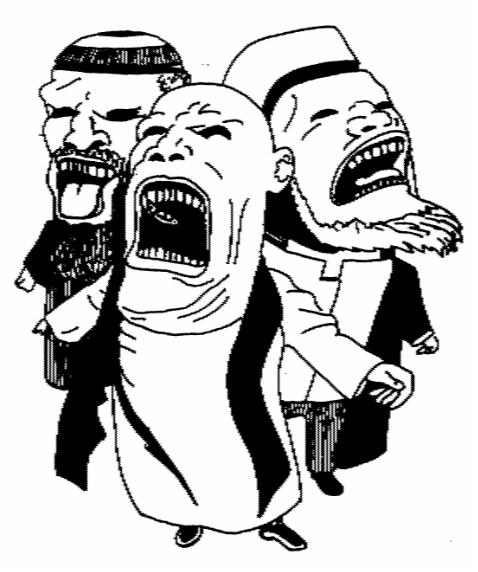
This tracing doesn't do the original justice, with
its brainless mullahs saying "Thru these lips speaks
God", and "The Book is right - the sky is
green" (that's the "How to Hook Book"). Would
the printers have looked at it differently if it was black men
with bones in their noses, or Orthodox Jews with flat hats and
ringlets?
|
(OHP
- Daily Mail)
|
|
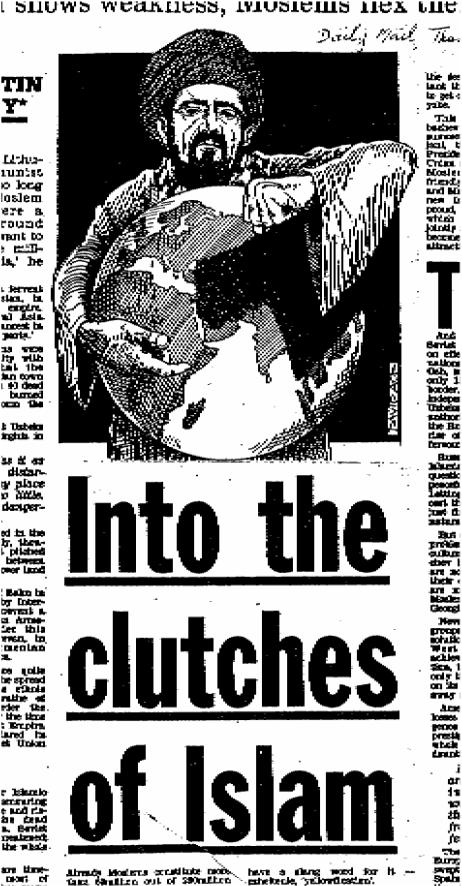
Or how about this from the Daily Mail (it's
years old, but the refrain is so frequent and regular it could
be yesterday) In fact it's about a minor armed flare-up in Osh
- a remote village in Khirgizia, near Uzbekistan. Important
national news? The problem with news is not calumny but
detraction, not outright lies, but a snippet of remote and
irrelevant truth which is portrayed as something normative.
And
it is not just the tabloids where Islam is concerned. This is
a theme that features regularly in Time and Newsweek, and our
liberal broadsheets are just as guilty. As Said says,
"... today's climate favours - one might even say
requires - Islam to be a menace".
I
had to stop taking the Observer, as I just couldn't bear to
face the weekly Islamic exposes. What finally broke me was a
huge spread on someone having their hands and feet hacked off
with a blunt knife for some minor theft in an example of
Islamic Justice in some remote African village. And there, of
course, is the key. This example of brutal muslim justice is
so normative that someone had to travel to a remote African
village to find it. But if something is important enough to
warrant a two page spread in the Observer does that not make
it real and relevant to muslim children?
But
then, who reads nowadays, people get their news from TV or
'bulletins' on the radio, and as someone with fairly strong
'media' connections this is a subject dear to my heart. The
control and manipulation of language and presentation achieve
what (at the risk of sounding like a conspiracy theorist) must
surely be a desired effect.
"Terrorism"
is a word only applied to the acts of a few violent
individuals, but for whom a whole population is held to be
responsible. It does not apply to our side, however, whatever
our actions. Indeed, there has been no justice for Lockerbie,
but who remembers the fully laden Iran Air passenger jet blown
out of the sky by a US Navy missile. No justice, no apology -
in fact, I think the response might have been
"Oops!". Well, the Iranians had been making
belligerent noises, so clearly it was their fault.
Do
we need a distraction from the political situation at home?
Well, let's bomb Libya! Of course, we didn't get Colonel
Gaddafi, but we got one of his kids - and the French Embassy,
but c'est la vie - as anyone who survived might have said. I
could go on and on, and this may all sound like a digression,
but muslims live with this every day. When Brigitte Bardot
says "Islamists have a mania for throat-cutting. I'm not
making it up. You just have to look at the television"
(Last Sunday's Independent - just after the story about forced
arranged marriages), she was partially correct. But she is
accused of provocation of hatred and racial discrimination,
not the TV companies.
It
never fails to surprise me how much people accept the language
and agenda of journalists without thought - let alone
challenge. When the Algerian elections were declared void a
few years ago after the united muslim opposition gained 82% of
the votes, my own son, a teacher, explained to me how the
government action was necessary as the opposition wanted to
"overthrow democracy". What democracy? Alice in
Wonderland has nothing on that kind of logic, and it's still
on the news nearly every day. "No one would want a muslim
Government in Algeria" said John Simpson on last week's
news - except perhaps the muslim population of Algeria.
Why
is the label "Christian" never applied to South
American dictators, or to drug runners like
"Christian" General Noriega even when he was
claiming sanctuary in the Vatican Consulate. Yet Saddam
Hussein is almost invariably shown praying or kissing the
Qur'an. At the risk of sounding paranoid, does no-one control
this policy? In the Bosnian conflict there were three warring
parties, two defined by religion, and one constantly and
insistently stressing their multi-faith and multi-ethnicity.
They were, of course, the Catholic Christian Bosnian Croats,
the Orthodox Christian Bosnian Serbs, and the Multi-faith and
Multi-ethnic Bosnian Muslims.
Of
150 talks on the BBC, the only time I have been seriously
censored was when I questioned the Islamic nature of the
butchery that takes place in the name of Saudi Arabian
justice. Even so, when my neighbour said "You must admit
the muslims really are a bloodthirsty bunch" she was
conveniently forgetting the Somme and Paschendale, Dresden and
Dachau. Prejudice is usually conveniently forgetful.
That
is the way prejudice works. Facts are rarely allowed to
disturb a prejudicial view. Prejudice is like science, it is
theory-led, and events that don't fit the theory are usually
discarded. So if muslim women are known to be downtrodden and
suppressed, then Benazir Bhutto in Pakistan and Begum Zia in
Bangladesh and the supporters that voted them into power must
be "not-really-muslim". If muslim women have had
independent wealth and property rights for fourteen centuries
which western women were still fighting for in the 1920's,
clearly what really matters is the right to take your clothes
off for the Daily Sport.
"Curioser
and curioser" said Alice.
Another
curious aspect of prejudice is the way that opposing sides use
the same terminology in reverse when referring to the other.
Thus education departments call what goes on in schools
education, as opposed to the inculcation of faith and personal
spiritual development within a parental religious tradition,
which is called instruction. Yet the First World Conference on
Muslim Education said this of education, that "it helps
in the complete growth of an individual personality, whereas
instruction is training to do some mental or physical task
efficiently. A man may be a fine doctor or lawyer, engineer or
accountant, and still be ill-mannered, unjust, amoral, cruel,
dissatisfied, unhappy, and obviously only partially
educated."
It
goes on "When we see an educated man what we recognise is
his "goodness".
A "good" man does not mean a "complete"
man, as there is no end to human growth throughout a life, so
an educated man is outward looking, modifying his
understanding and behaviour as his life is enriched with
knowledge and experience. This knowledge and experience, as
well as the basic values and assumptions on which it is based,
man learns from the society that surrounds him. He is an
individual and part of a structured community, and both are
necessary to the survival of each other, as unfettered
individualism means anarchy and the breakdown of all systems,
whereas excessive social control leads to stagnation,
degeneration, and violent social upheaval.
Education
preserves societal structures, conserving basic values and
understandings, and transmitting them to the next generation,
while at the same time looking to the reality of human needs
and interests in all their variety, by nurturing personal
growth, helping man to satisfy his yearning for a quality of
life through the understanding of fundamental values. A
quality of life which satisfies man's yearnings on many
different levels. How you understand this quality of life,
this aim of education, is basic to the way your education
system works.
What
we have there is essentially Islamic, but it is a view which
could have been voiced by many other faiths. As could the
contents of a muslim curriculum - Understanding God and
Creation, Divine Guidance and God's Relationship with Man,
Life and Death and the Afterlife - Consideration of Duties,
like Charity and Self-Restraint, Communal Unity, Striving for
Justice, Working for the Communal Good, and Giving and
Recognising Love and Respect. Recognising Good Behaviour -
Desirable Qualities and Hateful Vices, Right and Wrong Action,
and the ideal Way of Life. And then we need all the other
subjects - not excluding the history of muslim contributions
to knowledge that are all but ignored at present.
|
(OHP
- Map)
|
|
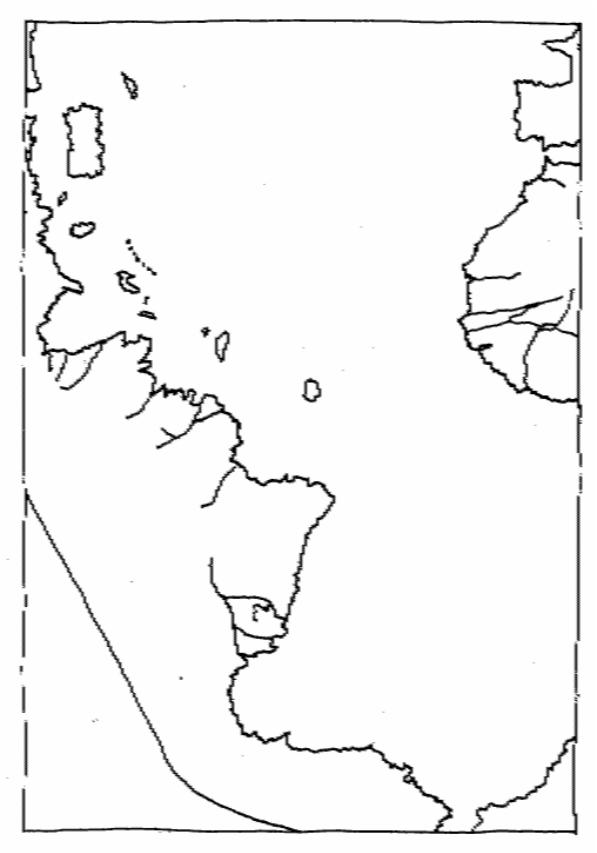
As a farewell present I'll show you one of my favourite
unheard of gems - a map by the muslim cartographer Piri Ra'is
made around about the time that Columbus was 'discovering'
America. Now even though my crude tracing really doesn't do justice to
the original, you can still see that if you head west from the
coast of Africa there, you come upon the coast of South
America (with the Amazon, Orinoco and other rivers mapped
quite some way inland), then heading north just past the West
Indies you can see Florida, and then you can keep going north
past New York to reach Greenland. But it was only mapped, not
invaded and colonised. How does that fit in with your
understanding of history?
Education
for life needs to be set in a faith context, a belief system
which gives it purpose. Our National Curriculum Guidelines
give tacit recognition to this, yet RE and PSD are allocated a
total of about an hour per week. It is a matter of priorities
- they are not mutually exclusive, but is it more important to
understand morality or differential equations? I was great at
differentials, but I can honestly say that I have never used
them since I was eighteen.
We
need to change, because it is not just muslim children who are
going through a crisis of identity. Prejudice springs not from
ease with one's own nature, but from fear and insecurity. I
firmly believe that for the health of our society it is time
to set our education system free of its secular straightjacket
and transform it into something more communally inclusive.
Such a change may be difficult, changes usually are, but I
refuse to believe it to be impossible. It is time to find a
way to make the cliche a reality - Education is not just for
childhood but for life.
|